
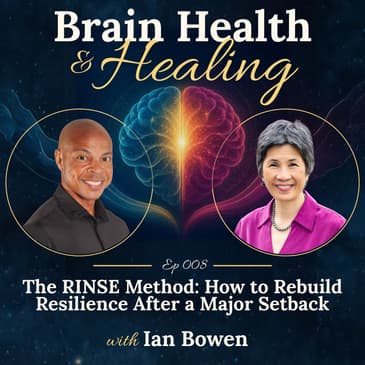
What happens when recovery becomes less about getting back to who you were and more about becoming who you are now?
Sandra talks with Ian Bowen about rebuilding identity, resilience, and self-belief after an unexpected medical crisis left him paralyzed from the chest down. When doctors told Ian he would likely need assistive equipment to walk and would never run again, he made a decision that shaped everything that followed: he would not allow someone else’s perception of his capabilities to become his reality.
Over time, Ian learned that moving forward was not about becoming the person he had been before. It was about becoming fully who he is now and recognizing the small wins that could rebuild momentum along the way.
He also shares the resilience framework that grew from his own recovery journey: Remember, Imagine, Notice, Shift, and Expect. Together, Sandra and Ian explore how looking back at past wins, visualizing what is possible, noticing progress, shifting focus, and preparing for both challenge and success can help you keep moving when life changes unexpectedly.
What might happen when you stop waiting to feel fully ready and start building resilience one small win at a time?
What You Are Invited to Discover:
- The mindset shift that helped Ian refuse to let someone else define what he was capable of.
- A different way to think about rebuilding identity when life no longer looks the way it once did.
- The small wins that can help restore belief, motivation, and momentum.
- Ian’s RINSE framework for remembering progress, imagining what is possible, noticing wins, shifting focus, and expecting challenge.
- What it means to build resilience before you need it and keep moving forward when setbacks come.
Get Ian's Rinse Method Playbook HERE
About the Guest:
In 2009, Ian Bowen’s life changed in an instant when complications from spinal cord surgery left him paralyzed from the chest down. At just 32, with two young children and a growing career, he was told he would never run again. Instead of letting that prognosis define him, Ian chose to keep moving forward. Through a long rehabilitation journey filled with small wins, setbacks, and relentless determination, he rebuilt not only his physical strength but also his belief in what was still possible.
That journey eventually led Ian to run two marathons and to create the RINSE Methodology, a framework built around remembering past wins, imagining what is possible, noticing progress, shifting perspective, and expecting both challenge and success. Today, through Positive Persistence and his Watch Me Mindset, Ian uses his story to inspire others to move beyond setbacks, reconnect with their potential, and refuse to let someone else’s perception of their capabilities become their reality.
Resources:
Share your Story with Sandra. Schedule a 10 minute call to share about your head injury, and how it has impacted your life - https://shinewithsandra.com/brainstory
Join Sandra Live on Facebook for Better Brain Briefs every Thursday at 8:00 a.m. Pacific, where you can ask questions and catch the replay for a limited time: https://www.facebook.com/SandraLeeInspiration/
Download your Free Audio Gift, Imagine What’s Possible, at https://shinewithsandra.com
Join the Brain Health & Healing Private Facebook Group - https://www.facebook.com/groups/brainhealthhealing
About the Host:
Sandra Lee has spent almost 40 years helping people feel and function better by addressing what standard treatment often misses: the unresolved trauma and emotional patterns stored in the body. She is the creator of The Spectrum of Anger™ and The Witnessed Body™, which integrates Intuitive Sound Healing and Combat Brain Training to support brain injury recovery, brain health, and dementia. Her work is grounded in the belief that symptoms are messages, not malfunctions, and that when those messages are finally received and released, the body can do what it already knows how to do.
Website -https://miracleinspirations.com
LinkedIn - https://www.linkedin.com/in/sandra-lee-701662250/
YouTube - https://www.youtube.com/@sandralee1miracleinspirations
Thanks for listening!
Thanks so much for listening to our podcast! If you enjoyed this episode and think that others could benefit from listening, please share it using the social media buttons on this page.
Do you have some feedback or questions about this episode? Leave a comment in the section below!
Subscribe to the podcast
If you would like to get automatic updates of new podcast episodes, you can follow the podcast on Apple Podcasts or your favorite podcast app.
Leave us an Apple Podcasts review
Ratings and reviews from our listeners are extremely valuable to us and greatly appreciated. They help our podcast rank higher on Apple Podcasts, which exposes our show to more awesome listeners like you. If you are enjoying the show, please leave us a review on Apple Podcasts.
Original theme music by Bradford Tilden.
Disclaimer: Everything you hear on this show is for educational and informational purposes only. It's not medical advice, and it doesn't diagnose or treat any condition. Please consult your medical practitioner before making health decisions.
Welcome to Brain Health and Healing. I'm Sandra Lee. This show is for people living with head injuries and the families and supporters who love them. If you are ready to reclaim your life, identity, and dreams for the future, you are in the right place. Welcome, everybody, to Brain health and healing, the new podcast. Brain health and healing, receiving adversity's gifts, and Ian Bowen is one of my special friends who I wanted to bring on the podcast for very particular reasons. He's one of the reasons that I got inspired to do this particular podcast in the first place. First of
Sandra Lee:all, and that he has such a wonderful story to share, going from injury and overcoming the adversity of that, and then having that go into the purpose that he carries forward into the world, and I just love the message that Ian is here to share with us. So, welcome, Ian. Tell us about yourself and your story.
Ian Bowen:Well, first of all, Sandra, I want to say thank you for providing the space and having me on the show, I am honored to be here. Yes, we are definitely special friends that connect on a certain level, and I think it's really important. And I'm so glad you have created this podcast because I think more people need to hear stories of overcoming adversity by regular people. What I like to to tell people that I talk to when I speak in front of groups is that I'm not a superhero, right? I don't have any superpowers. I'm just a regular person who just decided, and I want to put this at
Ian Bowen:the beginning of our conversation. Hopefully, I'm able to put it at the end. But if you don't get anything else out of this conversation for our listeners and our viewers here, I want you to remember this: that I just decided that I wasn't going to let someone else's perception of my capabilities become my reality. And without getting too far ahead of myself, sometimes that person is us, and we have to be careful about the thoughts that we have.
Sandra Lee:Oh my goodness, that's so important. Sometimes that limiting person, that limiting voice, is our own.
Ian Bowen:Yes. In this case,
Sandra Lee:you had other people as well who were giving you that message. But
Ian Bowen:yes,
Sandra Lee:most important one is your own.
Ian Bowen:Yeah, and I think a lot of us sometimes we don't even realize it that it is us that we're standing in our own way, but we'll get into that a little bit. So just to kind of briefly go through my journey and where I came to be a person that talks about positive persistence, that talks about resilience, and talks about overcoming adversity. It was in 2009. I was about 32 years old, and living life was great. I had a job where I was actually moving up the ladder. I was a young father. My daughter was six. My son was one, and life was going along just great. And then, out of the
Ian Bowen:blue, the universe decided to make things much harder. I developed a rare form of a rare disease called neurosarcoidosis, and this disease attacked my nervous system, and it started to grow a lesion inside my spinal cord. Now, at first, I had no idea what was happening because I was perfectly healthy. I've been an athlete all my life. You know, I was working out a couple days a week. I was running. Didn't have any type of markers that were going to say that this was coming. But I started to have some tingling sensations in my legs and in my chest. And over a period of about four weeks,
Ian Bowen:that led to me having issues getting up and ambulating out of a chair, so then I knew something something was wrong, and I'll save you all the details of doctor visits and everything. But how everything ended up is I ended up at the Mayo Clinic up in Rochester, Minnesota, with experts of the experts running all kinds of tests and everything coming back inconclusive. All we knew was that there was something growing rapidly inside my spinal cord that was causing me these deficiencies, and it was something that they needed to treat right away because it was growing fast. The only
Ian Bowen:problem was is that again we ran through all of these tests, and the doctors came back to me and said, "Look, there's one thing left that we can do. Since everything came back inconclusive, we have an idea that this may be a tumor growing, so it could be cancer, or it could be this disease called neurosarcoidosis. We need to go in and do a biopsy, and this is a last ditch effort because this is a very risky. Surgery, and they sat me down. I never forget this conversation with my neurosurgeon, my neurologist, saying, "You could be paralyzed for the rest of your life. However, we need to go in
Ian Bowen:and find out what this is, so we can have a correct course of action. Now, being 32 years old and having never broken a bone in my body, and being an athlete, I'm thinking, okay, let's do the surgery because you're going to go in, you're going to figure out what it is, you're going to fix me, and I'm going to be on my way. I was actually training for a 5K later on in the year. This was June at a 5K in August, so me being naive and never having broken a bone and not realizing what I was actually getting into, I was thinking, yeah, okay, let's do it. You're gonna fix me up. I'll be ready for my
Ian Bowen:race, and off I go. So I sign off on the surgery. Walk into the hospital that morning. When I wake up from that surgery, nurse says, "Good news, mr. Bowen. It's not cancer. It's what we thought it was. It's neurosarcoidosis, which is treatable, not curable, but the worst possible outcome had happened. From the chest down, I was paralyzed. No feeling, no sensation, no movement, no nothing. And at first, I didn't realize the depth of the situation because I thought it's just anesthesia; it'll wear off. Well, day two came, had more off, still paralyzed, chest down. Day three comes; I'm in my
Ian Bowen:recovery room, still nothing. That day, my care team comes in, the surgeons and my neurologists that were doing my surgery and on my case, and they start talking to me about my prognosis and what my future is going to look like, and they say, Ian, we think you're going to be able to walk again.
Ian Bowen:However, you're going to need some sort of durable medical equipment, meaning a walker, a cane, a crutch, something along those lines, and I don't know if I just didn't want to accept the moment because I didn't really take that in. Because my my next question was, well, am I ever going to run again? And I'm sure the look on my doctor's face again, I will never forget. Was he was perplexed, thinking like I just told this guy, he's not going to walk without medical equipment. He's asking me if I'm going to run, and his answer to my question is, "Doc, am I ever going to run again? He said,
Ian Bowen:"No. And in that moment, there was a little voice inside my head and inside my heart that said, watch me, and it's in that moment that I decided not to let someone else's perception of my capabilities become my reality. In that moment forward, I decided, and I promise myself, I will do everything in my power to get back to 100% of who I was before the surgery. Whatever it takes, I'm going to do it. I'm going to walk again.
Sandra Lee:That moment was critical.
Ian Bowen:Very.
Sandra Lee:That moment was critical because many people, upon hearing that, their inner voice would be the negative. Your inner voice immediately went to, watch me.
Ian Bowen:Yes, and I think why that was is because their outlook on my future was so distant, so different than my identity that I had for myself, know what my future was going to be. So I I took it personally, Sandra. I was, if I remember this moment, I remember me thinking like, "Do you know who you're talking to? Right, kind of like this cocky, 32 years old. You have no idea who you're talking to. Like, no, that's that is not going to be the way it is, Doc. I'm gonna show you. And you're right. That was a very pivotal moment because I could have accepted what they said, and if I would have
Ian Bowen:done that, there's a very good likelihood that I would still be walking with a walker, with a cane, with crutches, which are all the things that I started with on my rehabilitation journey. 12 years later, I ran my first marathon, first of two marathons. The second marathon was in Rochester, Minnesota, which is the city where I had my surgery. My neurology team, my care team, was waiting for me at the finish line, which was awesome. Great surprise! So I cross the finish line. They're cheering for me, and I give my neurologist a hug, my neurosurgeon a hug, and I tell him, "I don't know if I
Ian Bowen:should be hugging you right now or punching you in the face, because. It took me years to get over the fact that he told me no, like you're not gonna run again, and I was so mad. Like, why would you tell me that? But at the same time, he was the catalyst. He was the spark that challenged me. And if it weren't for that challenge, I don't know if I would have had that attitude of watch me, I'm going to do whatever it takes to get back to who I wanted to be. Now, with that being said, Sandra, I do have to also let everybody know that getting back to 100 of who I was pre-surgery was an
Ian Bowen:impossible task. That was never going to happen. It is not going to happen because I will never be the person I was before the incident, and it took me a long time to realize that. But what I came to realize is that I can be 100% of who I am now. Right, I can be who I am using what I have, where I am right now to move forward, because I will never be 32 years old again. I will never be that person again. I'm a new person, and every experience that I have, including that scenario where I wake up walking into the hospital that morning and waking up later on that afternoon, being paralyzed from
Ian Bowen:the chest down, using the negative and the positive experiences to build myself into who I am now, which is a choice, and we all have that choice.
Sandra Lee:This is a really important thing that I talk about. It's like when it comes to the significant injuries that occur to either the nervous system or the brain are often so impactful that you cannot get back to who you were before. You are building something newly. You are building who you are, not getting back the life you had.
Ian Bowen:Yes, and I truly believe that when you come up against resilience or adversity, you don't want to bounce back. You want to bounce forward, right? You're using that adversity. You're using that that hurdle that's in your way, that that wall that stands in your way. And I know what it feels like when you're in that position where you feel like the world is on your shoulders. But as a result to me having this surgery and being paralyzed from the chest down, I was demoted in my position at my in my job. Again, as I said, I was going up the ladder. I got demoted twice. My salary got
Ian Bowen:cut in half. I'm the breadwinner in my family. This is on top of losing my ability to walk, to stand. This was a huge hit to my ego, a huge hit to my my bank account, right? A huge hit to my way of life. But what I learned in that time was not to allow that circumstance to become my long term, right? I had this this mindset that this is temporary, and I think that a lot of us, when we get stuck in these situations, these adverse situations, we start to make these long-term decisions about a temporary situation. We might get into what I call the "woe as me"s. Why did this happen to me? What
Ian Bowen:am I going to do now? I'm always unlucky. This is unfair. What am I supposed to do now? But we have to ask ourselves in that moment: Are those thought processes serving me right now? And I will never forget.
Sandra Lee:Yeah, so much of how we define ourselves.
Ian Bowen:Yes, this is
Sandra Lee:something that I see all of the time when I read posts, for example, in Facebook from people who have these, they define themselves by their injury. They define themselves by their loss.
Ian Bowen:Yes,
Sandra Lee:and you chose his like, hey, I am who I decide I want to be. Powerful decisions,
Ian Bowen:and also we need to remember that if we break it down to our our actions that we're going to take in this situation, right? Whatever it is, coming back from an injury, coming back from job loss, divorce, whatever, we already know what's going to happen if we don't take any action. Things are going to remain the same, and if we're miserable, we're going to stay miserable. Why don't we find out what happens if we take the action, because for me, I knew what it was going. I knew it was going to be like. I'm going to be stuck, and if I don't take the action, I'm never going to change.
Ian Bowen:And someone who, for myself, going through this traumatic injury, going through the job loss, eventually going. Through divorce, you know, going through all of these hard times and adverse situations, there's again it goes back to that choice. Am I going to allow this situation to define me? Am I going to identify as this situation instead of identifying as myself? Because one of the things I talk about is when we have our mindset, meaning I think I can, and our heart set, meaning our conviction of I know I will. When those two things are in alignment, Sandra, I believe we are on fire. That's
Ian Bowen:when we're unstoppable, and that's when we achieve the unthinkable. That's when we're able to achieve the things that other people say you're not going to be able to do that. Who are you to think you can do that? No one else has done that before. You can keep your thoughts to yourself. Thank you very much. This is what I'm doing right here. I'm in alignment. I'm moving forward because that's who I identify as, and that's when we really get to tap into our potential when we start to drown out the naysayers, and we go to work on whatever we want to achieve, and we have that mindset of it doesn't
Ian Bowen:matter what I have to do because now the work becomes irrelevant, right? Doesn't matter how early I have to get up. Doesn't matter how many phone calls I need to make, how many reps of whatever I need to do, I need to get done. That all becomes irrelevant because my purpose is driving myself for it. My purpose is becoming the next best version of myself for me, not for anybody else. For me, so I can live the life that I'm meant to live, and it's all about, like you said, that purpose-driven, identity-driven action to become that next best version of yourself.
Sandra Lee:I find that something that very frequently gets in people's way is they don't have belief. It sounds to me like you had belief all along that it didn't get in your way.
Ian Bowen:That's true, and it's not true. So that's yes and no. Because in the beginning, yes, and throughout, I still am. I'm a very positive person. I do have that belief, but there are times that some belief wanes, right? Sometimes the scales tip, and the stress, the pressure, the the situation starts to really weigh you down, and it comes up here, and your belief starts to come down here, and that's normal, right? That's just human nature. That's just life, right? It's gonna happen. So through my experience, you know, I've created a framework that I use and that I teach and that I speak
Ian Bowen:on, and that framework is an acronym, and the acronym is RINS, and the R in RINS is Remember, and that's all about remembering all of the past wins that you've had already, remembering that you have been in this situation before. Now it could have been a different season in life, could have been a different event, but you've been in the situation where you feel depressed, you feel dejected, you feel marginalized, you feel like you have that limiting self-belief, but you bounced back. You were able to overcome. If you didn't, you wouldn't be where you are now. So remembering your past wins is
Ian Bowen:so important. And then the I is all about imagining. And this, for me, while I was in the hospital, as you can imagine, I had plenty of free time on my hands because I was stuck in my hospital bed, and I was there for about three and a half weeks, but I would imagine my outcome. I would imagine me walking again. I would use my imagination. But not only was I visualizing myself walking again, I would also think about how I was going to feel. So we talk about neuroplasticity. We talk about firing and wiring, we talk about all these things, but I believe when you're able to have that thought
Ian Bowen:of what you're going to be doing and how you're going to be feeling while you're doing it, bringing that emotion into it as well, that makes it all the more real. So imagining your outcome with that emotion of how you're going to be feeling in that moment starts to bring things towards you. It starts to actually make you more aware. So you start to have conversations that you might not have had before because you have this out here in the universe, right? That I'm going to achieve X, Y, Z. That's I'm going to feel while I do it. It starts to bring things into your periphery. You might hear
Ian Bowen:things that you might not have heard before. Again, you just become more aware because you're thinking about your success. And then along the way, the N stands for notice, and that's all about noticing your small wins. And this kind of goes back to the belief piece at an amazing physical therapy. That I saw five days a week for about a year and a half, and so we established a pretty good rapport. And so she would see the days that I would be coming in, and I would have that limiting self belief, where I wasn't feeling like I wanted to do the work, where I had the case of the woe is
Ian Bowen:me's. Why is this happening to me? Why am I not making more progress? Why aren't things moving faster? And she would let me sit in that for a minute. She would let me acknowledge those feelings and those emotions, and then she would snap me out of there. She would look me dead in the face. She would say, "Are you done now? Can we get back to work? So she would let me have my pity party, and then she would snap me out of it. And then she would say to me, "Ian, look at all the small wins you've had up until this point. Look at how far you've come. You were paralyzed in the in a hospital bed.
Ian Bowen:They told you that you weren't going to be able to walk in without a walker. Here you are now with a cane. Here you are now walking with two crutches. Look at all the progress that you've made.
Ian Bowen:And when we can look back on the small wins that we've had, we know what happens when we start to stack small wins one on top of the other. Eventually, they become big wins, and that's where we start to find not only some motivation but some momentum moving forward. And that moves us right into our next letter of the acronym of RINS, which is S, and that stands for shift, and that is shifting your mindset now, focusing on the things that you can do instead of focusing on the things that you can't do, which is so powerful because as we continue to prime ourselves with positive thoughts, they
Ian Bowen:yield positive outcomes. Now the E in rinse is a two-sided letter. One is that we need to expect our journey forward to be difficult. We can't expect it to be easy. That someone's just going to hand us our goals. Here you go. You don't have to do any work for it. And if we start to expect the journey to be hard, we can now create our standard for ourselves in which we're going to work to achieve that success, because we know that adversity is going to come again. It's not a question of if, it's a question of when. But if we expect it, now we're building mental fortitude. So now, when it
Ian Bowen:comes, we're ready for it. On the other side of that E, not only should we expect diversity, we should also expect to win. Like it is not over until I win. The journey's not done until I succeed. When we have that mindset again, you're on fire, and your success is just a matter of time.
Sandra Lee:Oh, okay. You listening? This is your gem for this episode. Ian just gave you like practical actions that you can take. So I recommend at the end of this podcast that you go back and listen to that again and write it down because this is like wisdom for everyday life. Thank you so much for that, Ian.
Ian Bowen:Sandra, if you don't mind, I will also be sending you a link for a PDF that you guys can click into for free to have all of that listed out for you and how you can use it in your practical everyday life as well.
Sandra Lee:Absolutely, that will be in the show notes. Wonderful. So, Ian, I love hearing about the whole journey. Like I was on top of the world, and then suddenly all this happened, and oh, like my life is going to be different. But hey, it's going to get better. I'm going to do it, and then the lessons that you pulled out of that journey that you now serve people with in the world. Tell us a little bit about how you carry this forward.
Ian Bowen:So one of the ways is that I host a podcast called Positive Persistence, where I bring people on, such as yourself, to talk about adversity, to talk about coming back from setbacks, bouncing forward, using that resilience. And when we talk about resilience, you know that is-I think it's a buzzword a lot of people use now, and it's a great word to use. But I want everybody to realize that we need to be building resilience before you need it, right? You don't want to be in that position where life hits you from the left field and you're not prepared for it because you don't
Ian Bowen:have any resilience built. But here's what I say: everybody has resilience built into their life already. They just might not realize it, and that's where we need to look back at our small wins and realize that we have overcome things before. And when we start to look back on that and say, "Oh, you know what? I was able to overcome adversity, big situations or small. Right? Most of us we don't remember that we. Learn to walk, but we did that right. Time and time again, we fell down, but we picked ourselves up. That's resilience. We fell down, and we learned along the way. Oh, this is how I
Ian Bowen:balance. This is how I walk, right? That's a little more recent for me because I had to do those things, learning how to rewalk again. But this is what I'm talking about: is these are these these instances in life that we've forgotten that we are more powerful than we realize because we have achieved greatness in other areas. We just marginalize ourselves by not realizing all of these past wins that we've had before, so building that resilience throughout your life, you already have it. You know, I've heard so many times throughout my my journey and self improvement, and listening to
Ian Bowen:mentors of mine from afar, and listening to speakers, and talking about you already have everything you need within you, and I was kind of blow it up. Like, okay, whatever. What what do you really mean by that? But it is true. You have everything that you already need in you to bounce forward from whatever situation you're in right now. You just need to give yourself permission to do it. We get buried by, as we started this conversation, off sometimes our own thoughts, our own limiting self beliefs. By maybe it's from someone else putting that on us, putting that label on us, but we choose
Ian Bowen:to believe them. Why choose to believe someone else limiting you other than you believing in your own self, your own abilities, having those thought processes of you know what? I can do this. Is it going to be hard? Yes. Do I have what it takes to make it? Yes. Am I gonna give up if it gets difficult? No, because why give up on myself? Because if I'm not gonna do the work for me, who's going to? And that is so important. And so through the Positive Persistence Podcast, I love bringing people on who have gone through adversity, who have bounced forward, who have frameworks, who have tricks,
Ian Bowen:tips, whatever else you want to share. Because again, as I mentioned in the beginning, it's so important for us to share this message with people that they are more powerful than they know. And the more stories you hear, hopefully, the more prone you are to believe that you can do it too. So I share that through my podcast. I share that through the coaching that I do. I also share that through the keynotes that I give.
Sandra Lee:So how do people connect with you?
Ian Bowen:So you can connect with me on my website, which is watchmemindset.com. You can also hit me up on socials where I am Ian R Bowen. You can find me on Facebook, Instagram, LinkedIn, as well as TikTok and all the socials that are out there, and of course, the Positive Business Podcast, which you can get anywhere.
Sandra Lee:Wonderful, wonderful. So, what is the last thing you want to leave our audience with? What do you want them to remember?
Ian Bowen:So to book in this conversation, as I mentioned in the beginning, I want to mention again because I think it's so important. Never let someone else's perception of your capabilities become your reality. And sometimes a person is you. Have the courage to stand up inside yourself. Get your mind right. Connect your heart set with your mindset. Tap into your potential, and you can achieve greatness.
Sandra Lee:There you go, audience. Take that message away with you! Thank you so much, Ian. It has been wonderful having you here,
Ian Bowen:Sandra. I appreciate you. Thank you so much for having me.
Sandra Lee:That's it for today. Thank you so much. We'll see you next time.
Ian Bowen:Bye bye.
Sandra Lee:Wasn't that a wonderful conversation with Ian. Go back and write some notes for the practical tips that he gave you. The rinse method, absolutely. And then go to my Facebook group, Brain Health and Healing, and tell me, what was the value that you took from this message today? I'd love to hear that. What difference is this going to make in your life? Thank you. I am Sandra Lee. Looking forward to seeing you in the next episode of Brain Health and Healing. Receiving.
Unknown:Adversity's gifts.